
What Dating App Subscription Tiers Should You Offer?
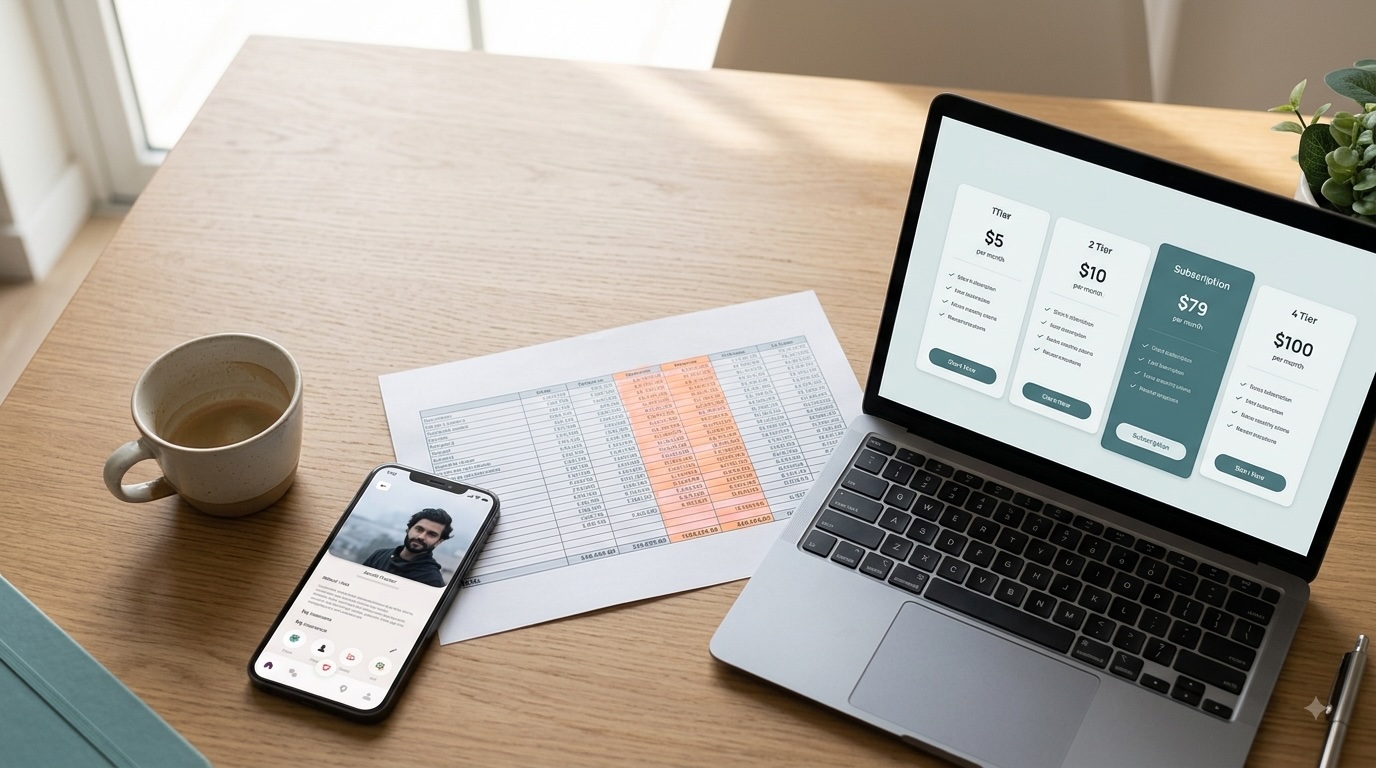
The subscription tier structure you choose directly determines your app’s revenue ceiling. Dating apps that offer 3–4 well-differentiated tiers generally outperform single-plan models, because a single price forces you to guess one willingness-to-pay figure for an audience that does not share one.
Before you set any price, you need a platform that supports flexible subscription billing. Most founders start by evaluating whether to build from scratch or license a ready-made script. If you’re launching with a PHP-based platform like MooDatingScript, you get built-in monthly subscription billing, a wallet-based credits system, and profile boost monetisation out of the box—no custom payment integration needed. For a deeper look at revenue mechanics, see how dating apps make money across six different models.
A note on the numbers in this guide: the only figures we can confirm are MooDatingScript’s own — the $149 one-time licence, the $100 PWA add-on, and managed hosting from $59/month. Conversion rates, churn rates, ARPU, and trial benchmarks vary enormously by market, niche, and app maturity; treat every percentage below as a planning range to model against and replace with your own cohort data as soon as you have it.
Here is a four-tier model that covers the full user lifecycle:
| Tier | Monthly Price | Target Conversion | Core Value Proposition |
|---|---|---|---|
| Free | $0 | 85–92% of users | Basic discovery, limited daily actions, ad-supported |
| Basic | $9.99–$14.99 | 3–5% of free users | Unlimited swipes, basic filters, ad-free experience |
| Premium | $19.99–$29.99 | 1.5–3% of free users | See who liked you, advanced filters, read receipts, profile boost |
| VIP | $39.99–$59.99 | 0.3–1% of free users | Priority visibility, exclusive badge, concierge support, all Premium features |
The Premium tier usually carries the bulk of subscription revenue because it sits at the psychological sweet spot—expensive enough to feel premium, cheap enough to be an impulse decision. The VIP tier exists partly as a pricing anchor: when users see $49.99/month, $24.99 suddenly looks reasonable.
Your ability to execute this tier structure depends on having a platform that supports multiple subscription levels, automatic recurring billing, and feature gating by plan. A dating app features checklist helps you map every feature to the right tier before you launch, so you never give away too much for free or lock something critical behind a paywall.
Feature Gating: What to Lock Behind Each Tier
Feature gating is where tier strategy succeeds or fails. Give away too much on the free tier and nobody converts. Lock too much and users churn before they experience value. The goal is to make the free tier useful enough to retain users for 7–14 days—long enough for the network effect to create FOMO—while making the Premium tier feel like an obvious upgrade.
Free Tier: Hook, Don’t Monetise
The free tier exists for one reason: build the user base fast. Every feature here should drive engagement, not revenue. Include:
- Profile creation with photos and bio
- Basic swipe-based discovery (limited to 10–25 right-swipes per day)
- Basic search with age and gender filters
- Messaging with matches only (not unsolicited DMs)
- Ad placements between profiles
The daily swipe limit is your primary conversion lever. When a free user hits “You’ve reached your daily limit” during an active session, that friction moment is where a large share of trial starts comes from.
Basic Tier: Remove Friction
The Basic tier at $9.99–$14.99/month targets users who are active enough to hit limits but not ready to invest in Premium. Include:
- Unlimited swipes and likes
- Ad-free browsing
- Extended search filters (lifestyle tags, interests)
- See who viewed your profile
This tier converts best when presented as a monthly auto-renewal with a 30% discount for annual billing. Annual Basic at ~$84/year locks in 12 months of predictable revenue and cuts involuntary churn from expired cards by two-thirds.
Premium Tier: Monetise Intent
Premium at $19.99–$29.99/month is your revenue engine. These users have high intent—they want results, not just access. Include:
- See who liked you (the single highest-converting paid feature in dating apps)
- Advanced filters (education, job, height, lifestyle tags)
- Read receipts on messages
- 1 free profile boost per month
- Rewind last swipe
- Incognito mode
Virtual gifts and credits add a second revenue stream on top of subscriptions. With a credits and virtual gifts system, Premium users spend an additional $5–$15/month on boosts, gifts, and visibility upgrades—pushing effective ARPU for this tier above $35/month.
VIP Tier: Monetise Status
VIP at $39.99–$59.99/month captures the 0.3–1% of users willing to pay for status and maximum visibility. Include:
- All Premium features
- VIP badge on profile (social proof)
- Priority placement in discovery stacks (2–3× visibility)
- 3 profile boosts per month
- Priority customer support
- Early access to new features
VIP users have 60–70% lower churn than Premium users because the status badge creates switching costs—removing the badge feels like a downgrade in social standing.
How Much Does It Cost to Run a Tiered Subscription Model?
The cost of implementing a multi-tier subscription model breaks down into one-time platform costs and ongoing operational expenses. Your biggest variable is whether you build custom or license a platform.
One-Time Costs
| Item | Cost Range | Notes |
|---|---|---|
| Dating platform licence (e.g. MooDatingScript) | $149 one-time | Full source code, subscription billing, credits system, and payment gateway integration included |
| PWA mobile app | +$100 one-time | Optional add-on for iOS/Android installable web app |
| Domain & branding | $10–$50 | Domain registration, logo design |
| Initial server/VPS setup | $20–$60/month (first month) | 2–4 GB RAM VPS on standard LAMP/LEMP stack |
| Payment gateway setup | $0–$50 | Stripe, PayPal, or CCbill merchant account setup fees |
| Total one-time (self-hosted) | $279–$449 | With PWA add-on |
Ongoing Monthly Costs
| Item | Monthly Cost | Annual Cost | Notes |
|---|---|---|---|
| VPS hosting | $20–$80 | $240–$960 | Scales with user base; 10k users on $40/month VPS |
| Managed hosting (optional) | from $59/month | from $708 | Requires the $149 licence first; hosting, technical support and maintenance included while active |
| Payment processing | 2.9% + $0.30 per transaction | Varies by volume | Stripe/PayPal standard rates; CCbill may differ |
| SSL certificate | $0–$10 | $0–$120 | Free with Let’s Encrypt on most hosts |
| Email/SMS service | $0–$50 | $0–$600 | Transactional emails, SMS verification |
| Total ongoing | $79–$199/month | $948–$2,388/year | Self-hosted; add $59/month for managed |
At just 30 Premium subscribers at $19.99/month, you generate $599.70/month—covering all ongoing costs with a $400+ monthly margin from month one. Every subscriber above 30 is pure profit, minus payment processing fees.
Hidden Costs That Eat Into Subscription Revenue
- Payment processing and chargebacks. Stripe and PayPal take 2.9% + $0.30 per transaction. Chargebacks cost $15–$25 each plus lost revenue. For dating apps—a high-chargeback vertical—budget 0.5–1.5% of transactions for disputes. Use CCbill if chargeback rates become a problem; it specialises in high-risk verticals.
- Involuntary churn from failed payments. 20–40% of subscription churn comes from expired cards, insufficient funds, or bank declines—not user intent. Implement dunning management (automated retry logic) and send pre-expiry emails. Every 1% reduction in involuntary churn adds $1,200–$6,000/year in retained revenue per 1,000 subscribers.
- Free-tier infrastructure costs. Free users consume server resources, bandwidth, and moderation time. At scale, 10,000 free users on a $40/month VPS works; at 100,000, hosting jumps to $200–$400/month. Budget for infrastructure scaling before it becomes a margin problem.
- Trial abuse and promo cannibalisation. Users who cycle through free trials with different emails cost you payment processing fees with zero revenue. Require phone verification to limit trial abuse. Promo codes that are too generous train users to wait for discounts—cap discounts at 30% and run them no more than twice per year.
- Customer support at scale. Paid users expect responses within 4–8 hours. At 1,000+ paying subscribers, you need dedicated support. Budget $500–$2,000/month for support staffing or automation once you cross 500 paid users.
- App store commissions (if you launch native apps later). Apple and Google take 15–30% of in-app subscription revenue. If you start with a PWA, you keep 100% of revenue minus payment processor fees. If you later launch native apps, factor the 15–30% commission into your pricing.
- Regulatory compliance costs. GDPR compliance, age verification, and content moderation are not optional. Budget $50–$200/month for compliance tools and legal review, especially if operating in the EU.
Trial Design: Converting Free Users to Paying Subscribers
Trial design is the single highest-leverage conversion tactic in your subscription funnel. The difference between a poorly designed trial and an optimised one is typically 2–5 percentage points of conversion rate—which on 10,000 monthly active users translates to $4,800–$12,000/month in additional revenue at Premium pricing.
Trial Length: 3 Days vs 7 Days vs 14 Days
| Trial Length | Conversion Rate | Best For | Risk |
|---|---|---|---|
| 3 days | 8–12% | Established apps with strong network effects | Not enough time to form matches and experience value |
| 7 days | 5–8% | Most dating apps (sweet spot) | Users may forget to cancel; some chargeback risk |
| 14 days | 3–5% | New apps building user base | High tire-kicker ratio; support costs for cancellations |
The 7-day trial with credit card upfront converts best for dating apps with an active user base. Users who send 5+ messages during the trial convert at 3–4× the rate of users who send 0–2 messages. If your user base is thin at launch, a 14-day trial without a credit card requirement builds the network faster at the cost of lower immediate conversion.
Credit Card Upfront vs No Card Required
Requiring a credit card for trials increases conversion to paid by 25–40% (because auto-billing kicks in) but reduces trial starts by 40–60%. For a new dating app, the trade-off is brutal: fewer trial starts means a thinner user base, which makes the app less valuable for everyone. Start without a credit card requirement for the first 3–6 months, then add it once you have 5,000+ active users.
ROI Calculator: When Does Your Subscription Model Break Even?
Investment (First Year)
Using the self-hosted model with MooDatingScript:
- Platform licence: $149 (one-time)
- PWA add-on: $100 (one-time, optional)
- VPS hosting: $40/month × 12 = $480
- Domain + branding: $50
- Payment gateway setup: $0
- Marketing (first 3 months): $500–$2,000
- Total first-year investment: $1,279–$2,779
Returns
Conservative scenario with 2,000 registered users and a 3% free-to-paid conversion rate:
- 60 paying subscribers × $19.99/month average = $1,199.40/month
- Annual subscription revenue: $14,392.80
- Minus payment processing (2.9%): −$417.39
- Minus hosting: −$480
- Net annual profit: ~$13,495
Payback Period
Formula: Total Investment / Monthly Net Profit
$1,779 / $1,124.53 = 1.6 months to break even
Even at the high end of the investment range ($2,779), break-even occurs within 2.5 months. After that, the platform generates positive cash flow. The payback period is this short because the platform cost is a one-time $149 licence rather than a recurring SaaS fee that compounds monthly.
Build vs Buy: Custom Subscription Engine vs Ready-Made Platform
| Factor | Build Custom | License Ready-Made (e.g. MooDatingScript) |
|---|---|---|
| Initial cost | $30,000–$150,000 | $149 one-time |
| Time to deploy | 6–18 months | 2–4 weeks |
| Subscription billing | Custom integration required | Built-in: monthly subscriptions, credits, profile boosts |
| Payment gateways | Integrate Stripe, PayPal, CCbill individually | Pre-integrated: Stripe, PayPal, CCbill |
| Ongoing maintenance | Your dev team | Monthly releases; 3 months free support and 1 year download access, both renewable |
| Customisation | Unlimited (at cost) | Full source code access—modify anything |
| Risk | High (scope creep, timeline overruns) | Low (proven platform, live demo available) |
The dating website development cost for a custom build typically runs $50k–$150k and takes 6–18 months before you collect your first subscription dollar. A licensed platform like MooDatingScript at $149 puts you in market in weeks, not months, and includes the subscription infrastructure you need—monthly billing, credits, boosts, and three payment gateways—without writing a line of payment code.
Is a Tiered Subscription Model Worth It?
Tiered pricing generally outperforms single-plan pricing on the metrics that matter to a dating app operator. The ranges below are planning benchmarks, not guarantees:
- ARPU improvement: Multi-tier models increase ARPU by 30–60% over single-plan pricing because they capture willingness to pay across the full user spectrum. The user who would pay $9.99 pays $9.99; the user who would pay $49.99 pays $49.99.
- Conversion lift: A well-structured free tier with daily usage limits converts 3–8% of active users to paid, compared to 1–3% for apps that gate the entire experience behind a paywall.
- Churn reduction: Annual billing options reduce monthly churn from 15–25% to 5–10% by locking in commitment. VIP tiers reduce churn further through status-based switching costs.
- LTV expansion: A Premium subscriber retained for 14 months at $24.99/month has an LTV of ~$350. Add $10/month in credits and boosts, and LTV reaches ~$490. With 500 Premium subscribers, that’s a $245,000 lifetime revenue base.
The intangible benefit: a tiered model gives you pricing power. You can raise Premium from $19.99 to $24.99 without losing subscribers because the VIP tier at $49.99 anchors perceived value. Single-plan apps have no such anchor—every price increase feels like a tax.
How to Reduce Churn and Maximise Subscription Revenue
- Push annual billing hard. Offer 30–40% off annual vs monthly. Display annual pricing as the default on your pricing page. Annual subscribers churn far less than monthly ones and carry a materially higher lifetime value.
- Use win-back pricing before cancellation. When a user clicks “Cancel Subscription,” offer one month at 50% off before letting them leave. This recovers 15–25% of would-be cancellations and buys 30 more days to re-engage them.
- Gate the highest-intent features behind Premium. “See who liked you” is the most effective paywall feature in dating apps. Users who receive 3+ likes during their first week and cannot see them convert at 2–3× the baseline rate.
- Segment pricing by geography. $24.99/month works in the US and Western Europe. In Southeast Asia or Latin America, $4.99–$9.99/month is the ceiling. Use geo-based pricing to maximise global revenue without pricing out emerging markets.
- Run a launch discount, not a permanent sale. Offer 50% off the first month for the first 90 days post-launch. This drives early paid adoption without permanently anchoring a lower price. After 90 days, revert to standard pricing for new subscribers.
- Monitor involuntary churn weekly. Set up automated dunning (retry failed payments at days 1, 3, 5, and 7) and send pre-expiry emails 7 days before card expiration. Reducing involuntary churn by 30% is the fastest margin win available—it requires no marketing spend.
- Add a credits economy on top of subscriptions. Subscriptions create recurring revenue; credits create transactional revenue. A wallet-based credits system for boosts, gifts, and visibility upgrades adds $5–$15/month in incremental ARPU on top of the subscription fee. This is pure margin with near-zero marginal cost.
The subscription infrastructure you choose determines how many of these tactics you can execute. A platform with built-in multi-tier billing, credits, and dunning management—like MooDatingScript with its Stripe, PayPal, and CCbill integrations—lets you implement all seven tactics from day one without custom development. For a step-by-step launch plan that covers everything from platform setup to your first paying subscriber, see how to start a dating website in 2026.