
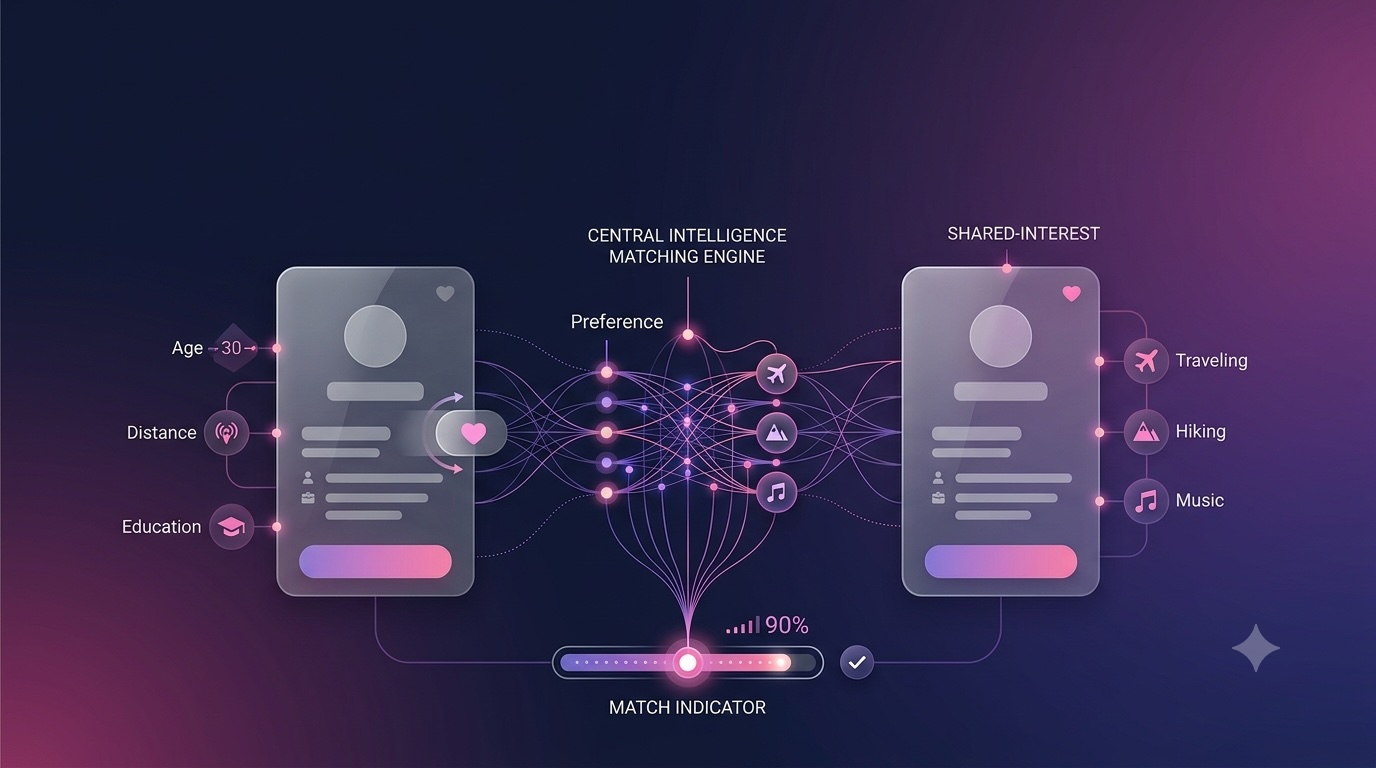
What Is a Dating App Matching Algorithm?
A dating app matching algorithm is the backend logic that decides which profiles each user sees, how those profiles are ranked, and what happens when two users show interest in each other. In a simple dating website, matching may start with filters such as age, gender preference, location, and interests. In a more advanced dating platform, the algorithm may also consider compatibility questions, profile completeness, activity, verification, user behavior, and AI-assisted recommendations.
The goal is not to make the system mysterious. The goal is to help users discover relevant people faster. A good dating app matching algorithm removes obvious mismatches, ranks stronger candidates higher, and keeps the discovery experience active enough for users to return.
How Dating App Matching Usually Works
Most dating platforms use a layered matching system. The exact implementation varies, but the core workflow is usually the same: collect useful profile data, apply hard filters, score the remaining candidates, then show profiles through search, recommendations, or swipe-style discovery.
1. Collect profile data
The algorithm starts with the information users provide. Common fields include name, age, gender, orientation, location, photos, bio, interests, relationship goal, education, job, lifestyle details, and optional matching-question answers.
This data matters because matching cannot work well with empty profiles. If the platform only knows a user’s age and city, the algorithm can only make basic recommendations. If the platform also knows interests, intent, activity, and compatibility answers, the discovery experience can become much more relevant.
2. Apply hard filters
Hard filters remove profiles that should not appear at all. These usually include age range, gender preference, location, city, distance, blocked users, banned users, incomplete profiles, and privacy settings.
Hard filters are different from ranking signals. If a user wants matches within a specific location, profiles outside that location should normally be excluded before scoring begins. This keeps the feed from feeling random.
3. Score compatibility signals
After filtering, the platform can score remaining profiles. Useful scoring signals include shared interests, matching-question overlap, profile completeness, recent activity, verification status, location proximity, and whether the user is likely to respond.
For a niche dating site, compatibility scoring is especially important. A religious dating platform, senior dating platform, professional dating site, or hobby-based dating community may need different signals from a generic swipe app.
4. Rank recommendations
Once profiles are scored, the system decides what to show first. A simple ranking may sort by match score, distance, or recent activity. A more advanced ranking may blend several signals so users see nearby, active, compatible, trustworthy profiles before lower-quality recommendations.
5. Learn from user behavior
As the site grows, behavior can improve recommendations. Likes, passes, matches, profile views, messages, blocks, reports, and response rates all reveal whether the discovery experience is working. The platform does not need heavy AI on day one, but it should give founders enough control to improve matching over time.
Swipe Logic vs Matching Logic
Swipe logic is the visible interaction: like, pass, match, skip, or message. Matching logic is the system behind that interaction. It decides which profile appears next, which profiles are hidden, what counts as a mutual match, and whether users can contact each other after matching.
A Tinder-style flow is mostly swipe logic from the user’s point of view. But the quality of the experience depends on the matching logic underneath. If the system keeps showing inactive users, distant users, fake profiles, or people with no shared intent, the swipe interface will not save the product.
What Signals Should a Dating App Use?
Most new dating sites do not need a black-box algorithm. They need a small set of useful signals implemented well.
- Location: nearby matches usually matter, especially for local dating communities.
- Age and preference filters: basic filters prevent obviously irrelevant profiles from appearing.
- Interests: shared hobbies and lifestyle details give users a reason to start conversations.
- Compatibility inputs: profile fields, interests, lifestyle tags, and other optional onboarding data can compare values, intent, habits, or niche-specific criteria.
- Verification status: verified profiles can improve trust and reduce fake-profile friction.
- Activity: recently active users are more likely to respond than inactive profiles.
- Profile completeness: complete profiles usually create more confidence and better interactions.
- Safety signals: blocks, reports, and moderation history should protect the discovery experience.
Not every site needs every signal at launch. A founder should start with the signals that match the niche, then expand based on real user behavior.
What MooDatingScript Supports
MooDatingScript is a self-hosted PHP dating script with full source-code access, so founders can launch with ready-made matching features while still keeping room for customization. Based on the current product facts and feature positioning, MooDatingScript supports several matching and discovery building blocks:
- Profile preference matching: matching based on gender, age, location, and dating purpose.
- Find a Match: discovery using profile preferences, interests, bio, and geolocation.
- Encounter: a swipe-style experience where users can quickly like profiles and view match score.
- Compatibility scoring: recommendations can use preferences, behavior, activity, location, interests, and popularity signals.
- Advanced profile filters: filtering by country, city, age, gender, interests, and lifestyle tags.
- Profile verification: phone/SMS verification, a blue-check badge, reporting tools, and contact blocking.
- Profile popularity and boosts: profile boosts, visibility upgrades, story-based boosting, and popularity ranking.
Because MooDatingScript includes full PHP source code with its commercial license, technical teams can modify matching behavior when the business needs deeper customization. That is a major difference from closed SaaS dating platforms, where the vendor controls the algorithm and customization is limited.
Rule-Based Matching vs AI-Powered Matching
Rule-based matching uses explicit logic: age range, gender preference, location, interests, compatibility inputs, and profile filters. It is predictable, easy to explain, and usually enough for an early dating site.
AI-powered matching can add smarter recommendations when the platform has enough data. It may help rank profiles, interpret profile text, improve recommendations, or detect patterns in user activity. But AI is not a replacement for clean profile data, clear preferences, trust controls, and a usable discovery flow.
For founders, the practical path is simple: launch with configurable rules, collect behavior data, then improve recommendations as the community grows.
How Matching Algorithms Differ by Dating Product
Large consumer dating apps often use proprietary ranking systems that are not fully public. Public references to swipe apps, compatibility systems, and recommendation engines can be useful, but they are not copy-and-paste blueprints for a new niche dating business.
The better question is: what does your audience need to trust a match?
- A local dating site may prioritize distance and recent activity.
- A religious dating site may prioritize values, lifestyle, and relationship intent.
- A senior dating site may prioritize safety, profile detail, and location.
- A professional dating site may prioritize education, industry, goals, and verification.
- An LGBTQ+ dating app may need orientation, privacy controls, location sensitivity, and safety features.
This is why configurable matching matters. Generic matching may work for a broad app, but niche dating sites usually need rules that reflect their community.
Cold Start: What Happens Before You Have Enough Users?
Every new dating platform has a cold-start problem. The algorithm cannot recommend many relevant profiles if there are not enough active users in the same location or niche.
Founders can reduce this problem by launching in one city, one niche, or one audience segment first. They can also use profile completeness prompts, verification, onboarding questions, and clear filters to make early matches feel more relevant.
MooDatingScript includes profile seeding for launch-stage operations, but founders should use any seeding carefully and transparently. The long-term goal is real active users, not artificial activity.
Founder Checklist for Matching Features
- Can users set age, gender, location, and intent preferences?
- Can users provide enough niche-specific profile details to support relevant recommendations?
- Can the platform calculate or display compatibility scores?
- Can verified profiles be identified?
- Can inactive, incomplete, blocked, or reported profiles be handled properly?
- Can users discover matches through search, filters, and swipe-style flows?
- Can the matching logic be changed as the niche grows?
- Can boosts or popularity features be monetized without making matches feel pay-to-win?
- Can the founder test the matching flow before launch?
Why Source Code Ownership Matters for Matching
Matching is one of the hardest parts of a dating business to outsource completely. Your niche may need rules that a generic SaaS platform does not support. You may want to change scoring weights, add custom questions, adjust location rules, surface verified profiles differently, or connect matching to monetization.
With a closed platform, those changes depend on the vendor. With a self-hosted dating script that includes source code, your team has more control over the matching experience, the data model, and the roadmap.
Final Recommendation
A dating app matching algorithm does not need to be mysterious or overly complex. For most founders, the best system starts with strong profile data, clear filters, location-aware discovery, verification, activity signals, and enough flexibility to improve over time.
If you are comparing dating software, review the MooDatingScript feature list, check the current pricing, and try the live demo to see how matching, discovery, and profile flows work in practice.