
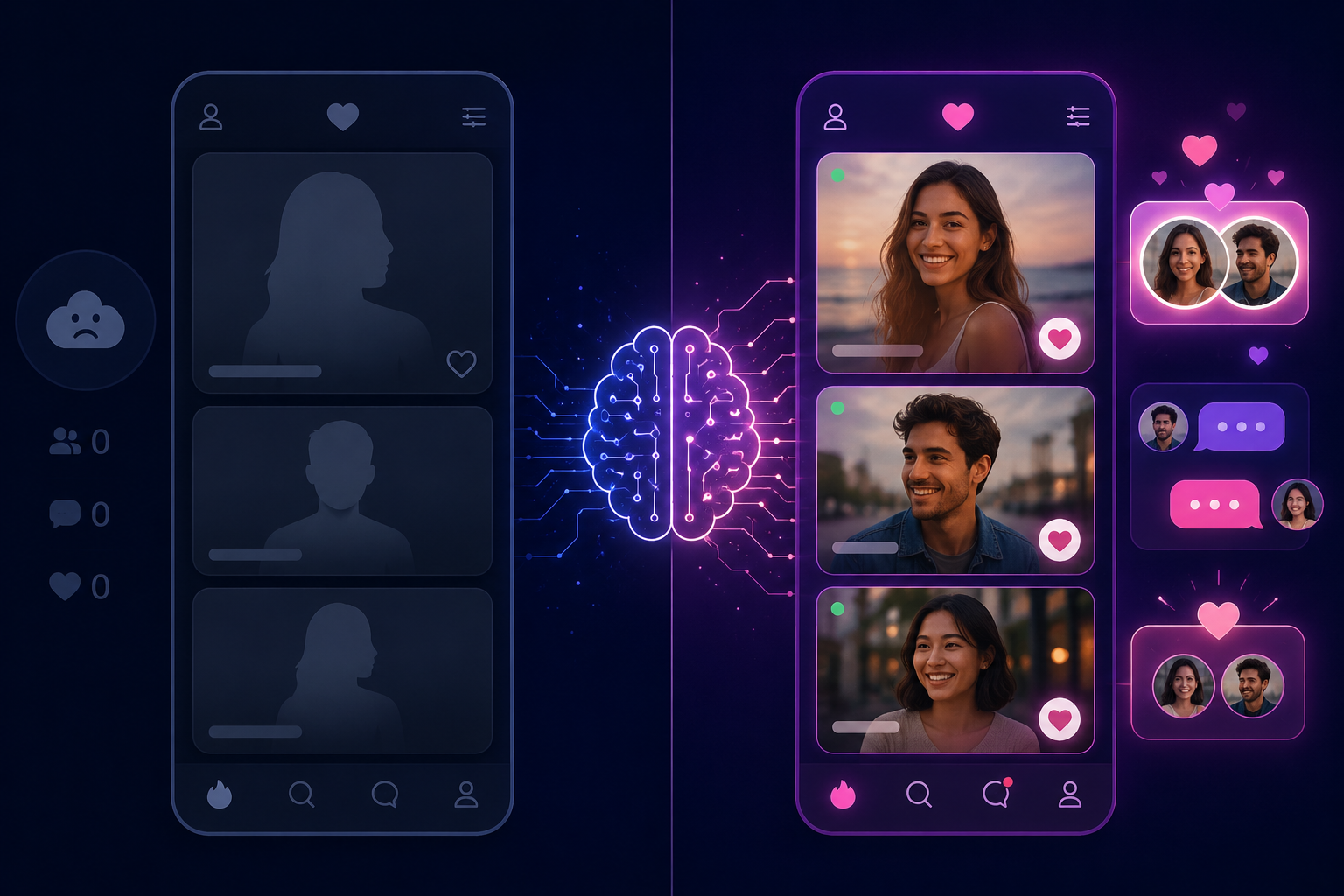
How AI-Powered Fake Profiles Solve the Biggest Problem in Dating App Growth
Every new dating platform faces the same problem the moment it launches: it feels empty. New members sign up, browse a thin list of profiles, send a message or two into silence, and leave — often never to return. This is the cold-start problem, and it kills more dating platforms than poor design or weak features ever could.
Fake profiles — also called sub-profiles — have long been the industry’s answer to this problem. But basic fake profiles have real limits. AI changes that calculus entirely.
What Is the Cold-Start Problem for Dating Platforms?
The cold-start problem is simple: a dating platform only becomes valuable when it has users, but it can’t attract users without already being valuable. It’s a two-sided marketplace problem that every new platform faces, and dating apps feel it more acutely than most.
Dating is inherently dependent on reciprocity. A social network can survive with mostly passive users reading content. A dating app cannot. Members need to receive views, likes, and messages — ideally quickly — or they conclude the platform is dead and move on. Research consistently shows that first-session engagement is the single biggest predictor of whether a new member will return.
For platform operators, this creates an impossible early window: you need to manufacture activity before organic activity exists, without making the experience feel fake.
What Are Fake Profiles and Why Do Platforms Use Them?
Fake profiles — referred to as sub-profiles in most dating software — are operator-controlled accounts that simulate real member activity. They browse profiles, send likes, trigger matches, and initiate or respond to conversations. The goal is to make the platform feel active during a period when real user density isn’t yet high enough to sustain organic engagement.
This is a well-established practice in the dating industry. Platforms of all sizes have used some version of it, particularly in their early growth phases. Done transparently — with proper disclosure in terms of service — it’s a legitimate tool for solving a genuine product problem.
At a basic level, sub-profiles can:
- View real member profiles to trigger “someone viewed you” notifications
- Send likes to encourage return visits
- Generate matches to give members something to respond to
- Send an opening message to start a conversation
These actions create enough activity to keep new members engaged while the real community grows. But they come with a ceiling.
Why Basic Fake Profiles Are No Longer Enough
The problem with traditional sub-profile systems is that the conversation quickly breaks down. A fake profile can send an opening message, but the moment a real user replies, the system has nothing meaningful to say back. Operators either leave conversations dead — which defeats the purpose — or manually write responses, which doesn’t scale.
Users have also become more discerning. A message that feels generic or disconnected from their profile signals something is off. The uncanny valley of digital interaction is real: an almost-convincing experience is worse than no experience at all, because it breeds distrust rather than engagement.
Basic fake profiles solve the visibility problem. They do not solve the connection problem. And connection — or at least the convincing promise of it — is what keeps people on a dating platform.
How AI Closes the Gap
AI-powered sub-profiles change the equation because they can actually respond — not with scripted fallbacks, but with context-aware replies generated from the real user’s own profile data.
Here’s how it works in practice. When a real member messages a sub-profile, the AI reads that member’s profile — their listed interests, relationship goals, lifestyle details, and stated preferences — and generates a reply that references what it finds. If someone lists hiking and cooking as interests, the AI-generated response might pick up on those. If their relationship goal is something serious, the tone adjusts accordingly.
Operators can also configure the personality style of each sub-profile:
- Friendly — warm, conversational, approachable
- Flirty — playful, light teasing, higher energy
- Serious — measured, direct, focused on compatibility
- Custom — operator-defined tone for niche platforms
The result is a conversation that feels plausible long enough to matter. Users stay engaged, return to the app to check responses, and develop enough investment in the platform to wait for real matches to emerge.
The Full Engagement Funnel AI Unlocks
The real power of AI-powered sub-profiles isn’t any single interaction — it’s the complete funnel they enable. Previously, fake profiles could handle the top of the funnel: discovery, views, and likes. AI extends that funnel all the way through to sustained conversation.
The full flow looks like this:
- Discover — Sub-profile appears in the real member’s browsing feed
- View — Sub-profile views the real member’s profile, triggering a notification
- Like — Sub-profile likes the profile based on compatibility signals
- Match — A match is created, giving the real member something to act on
- AI Chat — Conversation begins and continues naturally through AI-generated replies
Each step increases the real user’s investment in the platform. By the time they’re mid-conversation, they’re no longer a passive browser — they’re an engaged member waiting to see where the connection goes. That’s exactly the behavioral shift operators need to drive retention.
What This Means for Platform Operators
From an operations standpoint, AI-powered sub-profiles reduce the manual overhead of managing fake profile systems significantly. There’s no need to monitor conversations and intervene when a real user replies. The AI handles it.
More importantly, it changes the strategic value of sub-profiles from a short-term fix into a genuine growth tool. Rather than simply making a new platform look populated, AI-driven fake profiles actively retain members during the critical early period — long enough for real community density to develop.
The right way to think about it: sub-profiles are a bridge, not a destination. AI makes that bridge longer, sturdier, and far less likely to collapse under the weight of a real conversation.
Once the platform reaches healthy organic activity — where most members are receiving genuine matches and messages from real users — sub-profile engagement can be dialed back. By that point, the community sustains itself.
Frequently Asked Questions
Are fake profiles legal on dating platforms?
Using fake profiles is a common industry practice, but it must be disclosed in your platform’s terms of service. Most dating scripts and platforms include a terms clause covering simulated profiles used for engagement purposes. Operators should ensure their terms are clear and legally reviewed for their jurisdiction.
How is AI fake profile chat different from basic bots?
Basic bots send scripted, one-size-fits-all responses regardless of who they’re talking to. AI-powered fake profiles read the real user’s profile data — their interests, relationship goals, and personality details — and generate context-aware replies that feel relevant to that specific person. The difference in user experience is significant.
When should an operator phase out fake profile engagement?
Fake profile activity works best as a bridge during the early growth phase. Once a platform reaches a healthy ratio of active real users — typically when most members consistently receive organic matches and messages — operators can gradually reduce fake profile activity and let the community sustain itself.
Can users tell the difference between AI chat and real users?
Well-implemented AI chat is difficult to distinguish from real conversation, especially in early exchanges. The key is that AI chat keeps users engaged long enough for real matches to develop — it’s a retention tool, not a permanent substitute for genuine connection.
Does AI-powered fake profile chat work on mobile apps?
Yes. AI chat operates at the platform level, meaning it works across web and mobile app versions simultaneously. Any message sent by a real user — regardless of device — receives an AI-generated response from the sub-profile.