
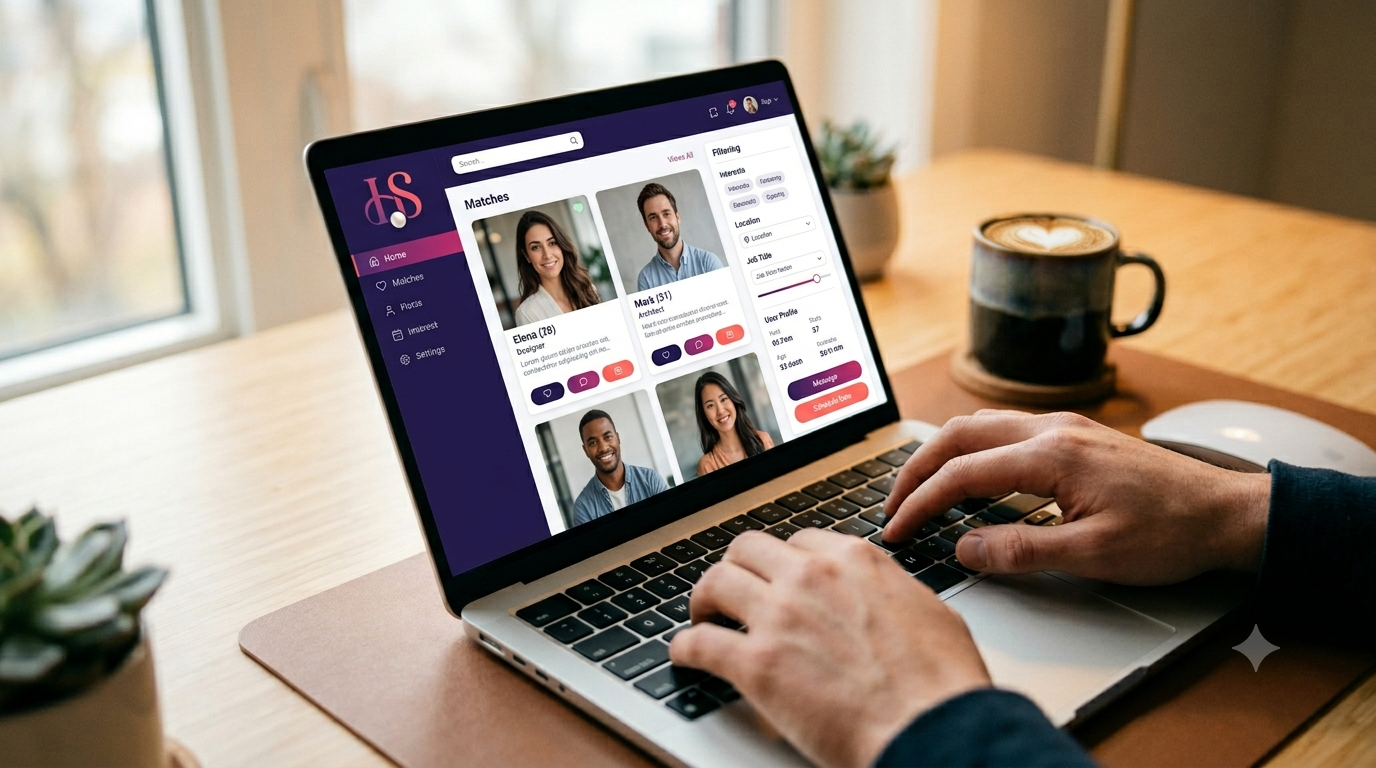
What Is White-Label Dating Software?
White-label dating software is a pre-built, fully functional dating platform that you can rebrand and operate under your own name. Instead of spending $30,000–$150,000 and 6–12 months building a dating site from scratch, you purchase a ready-made dating script, apply your logo and colors, configure your domain, and launch — often within 3–7 days.
The term “white-label” means the software vendor builds the product, but your users see only your brand. The vendor’s name does not appear anywhere on the user-facing site. You set the pricing, control the user data, and own the customer relationship. As explained in our guide to source code ownership, most white-label platforms include full source code, letting you customize every aspect of the platform for your specific market.
This model sits between two extremes: paying monthly for a restricted SaaS platform you don’t control, and spending a fortune on custom development. For entrepreneurs who want speed, control, and a manageable budget, white-label software hits the sweet spot.
How White-Label Dating Software Works
The workflow is straightforward. Once you buy a license, the process follows five steps:
- Purchase a license. One-time fees for self-hosted licenses range from $149 to $1,599 depending on features and source code access. Some vendors also offer managed hosting plans starting around $59/month.
- Install the software. On a self-hosted plan, you deploy the script to your own server. Managed plans skip this step — the vendor handles hosting and installation.
- Apply your branding. Replace the default logo, colors, site name, and domain with your own brand identity.
- Configure the platform. Set up matching rules, subscription pricing, payment gateways, verification settings, and content pages.
- Launch and acquire users. Once configured, your dating platform is live. The vendor provides ongoing updates and support while you focus on growth and monetization.
This is fundamentally different from custom development, where every feature — profiles, matching, chat, payments — must be designed, coded, and tested from zero. With white-label software, 90%+ of the technical work is already done.
White-Label vs Custom Development: The Numbers
If you’re weighing options, the cost and time differential is the deciding factor. Here is how the two approaches compare across the metrics that matter most:
| Factor | White-Label Software | Custom Development |
|---|---|---|
| Upfront cost | $149–$999 one-time | $30,000–$150,000 |
| Time to launch | 1–7 days | 6–12 months |
| Source code access | Usually included | Full ownership |
| Ongoing costs | Hosting ($20–$100/mo) + optional support renewal | Developer salaries ($8,000–$15,000/mo) + hosting |
| Customization depth | Modify existing features; build on the codebase | Unlimited — build anything |
| Risk profile | Low — proven, tested codebase with user base | High — untested code, no track record |
| Vendor dependence | Moderate — need vendor for updates | Low — you own everything |
The data is clear: unless you have a seven-figure budget and a unique feature set no existing platform covers, white-label software is the faster, safer, and dramatically cheaper path. If you want to build a dating app without coding, white-label platforms are designed specifically for that use case.
White-Label vs SaaS Dating Platforms
A common point of confusion is the difference between buying white-label software and subscribing to a SaaS dating platform. They serve opposite philosophies:
| Factor | White-Label (Self-Hosted) | SaaS Platform |
|---|---|---|
| Payment model | One-time license fee | Recurring monthly subscription |
| Source code | Full access (with most vendors) | No access — you rent the software |
| Data ownership | You own all user data | Vendor controls the database |
| Exit risk | Low — you keep your installation | High — vendor shutdown = you lose everything |
| Customization | Deep — modify any part | Surface-level — limited to settings panel |
| 5-year cost (est.) | $149 + hosting (~$1,200–$6,000) | $3,540–$8,940+ (at $59–$149/mo) |
With a SaaS platform, you are renting someone else’s system. With a self-hosted white-label script, you own your installation outright — a one-time purchase gives you a perpetual license to run the software on your domain for as long as you want.
Key Features to Look For in White-Label Dating Software
Not all white-label dating scripts are created equal. When evaluating options, use this checklist as your benchmark. If you’re comparing multiple vendors, see our roundup of the best PHP dating scripts for a side-by-side feature breakdown.
| Category | Must-Have Features | Why It Matters |
|---|---|---|
| Profiles & Discovery | Rich user profiles, swipe-based matching, advanced search filters, location-based discovery | Core user experience — without it, users won’t stay |
| Matching Algorithm | Configurable matching rules, compatibility scoring, AI-powered recommendations | Match quality drives retention and word-of-mouth growth |
| Messaging | Real-time 1-to-1 chat, photo sharing, GIFs, emoji reactions | Messaging is the primary engagement driver post-match |
| Monetization | Subscription tiers, credit/wallet system, profile boosts, multiple payment gateways | Your entire revenue model depends on flexible monetization |
| Trust & Safety | Phone verification, identity badges, report/block tools, GDPR compliance | Safety features are non-negotiable for user trust and legal compliance |
| Mobile Support | Responsive design, PWA or native app option, dark mode | 70%+ of dating app usage happens on mobile devices |
| Admin Panel | User management, revenue dashboard, profile seeding, multi-language support | You need operational control without hiring a developer |
| Source Code | Full, unencrypted PHP/backend source code with no usage restrictions on your own site | Without source code, you cannot customize or fix issues independently |
White-Label Licensing: What You Actually Get
This is where entrepreneurs get burned. The phrase “white-label” tells you that you can rebrand the software — it does not tell you what else you can do with it. License terms vary dramatically between vendors. Here is what to verify before buying:
- Domain limits. Most licenses cover one domain. Running multiple dating sites requires multiple licenses.
- Transferability. Many perpetual licenses are nontransferable. If you plan to sell your dating business, the buyer will likely need to purchase their own license — even though your user base, brand, and domain are yours to sell.
- Resale and sublicensing. Most white-label licenses explicitly prohibit reselling, sublicensing, or offering the software as a hosted service to third-party clients. White-label means rebranding for your own business, not building sites for clients.
- Source code rights. “Full source code included” typically means you can modify the code for your own internal use. It does not mean you can distribute your modified version, sell it, or open-source it.
- Perpetual vs renewable. A perpetual license means you can run the software indefinitely on your domain. Support and update access may be time-limited and require renewal.
Read the license agreement before buying. A $149 one-time license that includes full source code and a perpetual right to run the software on your domain is fundamentally different from a $79/year subscription that revokes access when you stop paying.
Common Mistakes When Choosing White-Label Dating Software
- Not testing the demo thoroughly. A feature list on a sales page is not the same as seeing the software in action. Spend at least 30 minutes in the demo: create a profile, run a search, send a message, check the admin panel, and test it on mobile. If the demo feels slow or buggy, the live product will too.
- Ignoring mobile UX. Over 70% of dating activity happens on phones. If the platform is not fully responsive or lacks a PWA, you are launching with a critical handicap. Verify mobile performance in the demo before buying.
- Skipping the license agreement. Entrepreneurs often focus on features and pricing while overlooking license terms — then discover too late that they cannot transfer the license, run multiple domains, or modify the code the way they planned.
- Underestimating server costs. A $149 license is not your only cost. You need a VPS or dedicated server ($20–$100/month), a domain ($10–$15/year), SSL certificate, and potentially a CDN for media. Budget realistically for ongoing operations.
- Choosing the cheapest option without checking update frequency. A script that hasn’t been updated in 18 months is a security and compatibility risk. Look for vendors shipping monthly updates with clear changelogs — it signals an actively maintained codebase.
Who Should Use White-Label Dating Software?
This model works best for three specific profiles:
- First-time dating entrepreneurs who want to test a niche — launch your own brand without writing code and validate the market before investing heavily.
- Existing community or media owners who already have an audience and want to add a dating layer. A white-label platform integrates as a standalone site under your brand umbrella.
- Technical founders who want a head start. Starting from a proven PHP codebase with full source access lets you build custom features on top of a working foundation rather than reinventing profiles, matching, and chat from scratch.
White-label software is less suitable for enterprises requiring a fully bespoke feature set with no overlap with existing platforms, or for agencies looking to resell dating platforms to multiple clients — that use case typically violates standard license terms.
The Bottom Line
White-label dating software is the most capital-efficient way to enter the dating market in 2026. A one-time license starting at $149 replaces $30,000–$150,000 in development costs and 6–12 months of build time with a launch window measured in days. You get a proven, feature-complete platform — profiles, matching, chat, payments — that you own and control, with full source code access to customize as your business grows.
The key is due diligence: test the demo, read the license, verify mobile performance, and budget for ongoing hosting. Do those four things, and you can go from idea to live dating platform in under a week.